Short answer
A deeper well can sometimes improve a property's water-supply options, but depth alone does not guarantee greater yield, better quality, or protection from drought. The useful question is what water-bearing interval the proposed depth will reach and how that interval is expected to perform.
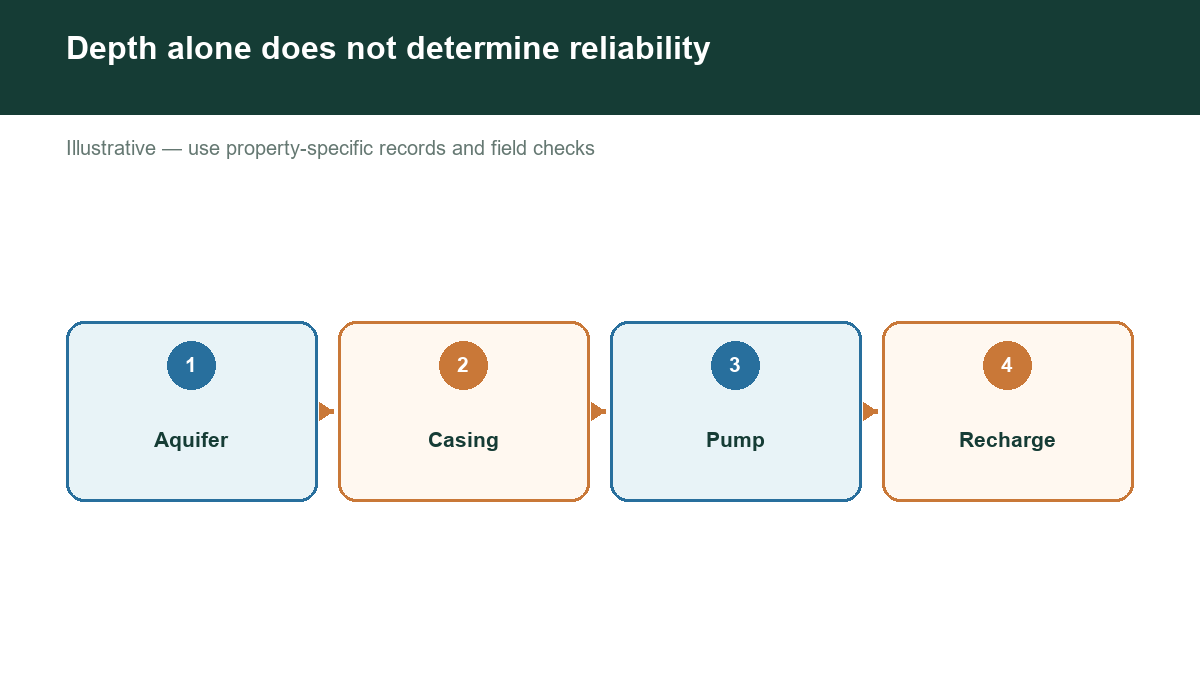
USGS explains that the ability of rock to supply groundwater does not have a simple, consistent relationship with depth. Some formations transmit water readily; others do not. [1] Drilling farther through a poorly productive formation may add footage without solving the supply problem.
SEPARATE DEPTH FROM PRODUCTIVE COMPLETION
Total depth is the bottom of the borehole. Productive completion describes the interval through which groundwater enters. A longer borehole does not mean all of its length supplies usable water.
For illustration, a 500-foot well could obtain most of its production from a relatively limited interval. A shallower well in another setting could produce more. These are conceptual examples, not predictions for a Texas county or aquifer.
When reviewing a drilling proposal, ask for the target formation, expected completion, supporting nearby records, and contingency if the target is less productive than anticipated. A written explanation is more useful than "deeper is safer."
WATER QUALITY MAY CHANGE WITH DEPTH
Texas has substantial brackish groundwater resources. TWDB's Brackish Resources Aquifer Characterization System maps and studies those resources using well reports, geophysical logs, and aquifer data. [2]
This does not mean all deep water is brackish. It means that more water at depth is not necessarily water that suits the property's intended use without additional treatment.
Ask whether the deeper target has documented local chemistry, whether nearby wells have laboratory results, and what treatment might be required. Include testing and treatment in the comparison rather than comparing only drilling prices.
THE WATER LEVEL, NOT JUST THE BOTTOM, AFFECTS PUMPING
Pump selection depends on the operating water level, delivery pressure, friction losses, and desired flow. A deep borehole with water standing relatively high is not the same pumping problem as a well with a much deeper pumping water level.
As water levels decline, a well's available drawdown and performance can change. USGS well-performance guidance discusses the importance of static level, specific capacity, and the lowest practical pumping level. [3]
Ask the installer to explain the planned operating range and how the system will respond during low-water conditions. A deeper pump setting is not automatically a remedy for an aquifer or well that cannot replenish water fast enough.
DIAGNOSE BEFORE DEEPENING AN EXISTING WELL
If a well loses pressure or stops producing, investigate equipment and plumbing as well as groundwater conditions. Do not authorize deepening solely because a faucet ran dry.
Have a qualified professional evaluate the water level, pump, controls, casing, sediment, and recent use. If deepening is considered, ask whether the existing well can be altered safely and appropriately, what additional formations might be penetrated, and which approvals apply.
TDLR provides technical guidance for well drilling and pump installation under Texas requirements. [4] A proposed alteration should be evaluated through that framework and any applicable local rules.
COMPARE COMPLETE WATER-SYSTEM OPTIONS
Evaluate a new deeper well against alternatives appropriate to the property. Depending on the diagnosis, those might include repairing the current system, managing peak demand, professionally designed storage, or a utility connection where available.
Request written assumptions for each option: expected supply, evidence quality, treatment, operating expenses, maintenance, and unresolved risks. A low-price option with weak evidence and a higher-price option with a credible design should not be compared on price alone.
WHAT NEARBY RECORDS CAN CONTRIBUTE
Nearby well reports can suggest local completion practices and reveal variation. Sort them by formation, use, age, and location rather than assuming the deepest record is the best model for your site.
If evidence is sparse, identify that limitation before choosing a target depth. Public records cannot replace a site-specific drilling evaluation or guarantee the outcome.
RESEARCH BEFORE ADDING FOOTAGE
Visit https://www.groundwaterassessment.com/ to begin researching groundwater evidence near your Texas property. Use the findings to ask a licensed professional whether a deeper target addresses your actual supply problem.