Short answer
Rain on a Texas property is encouraging during drought, but rainfall and groundwater recharge are not the same thing. Some rain becomes runoff, some stays in soil, and some returns to the atmosphere. Only water that reaches the groundwater system contributes to recharge.
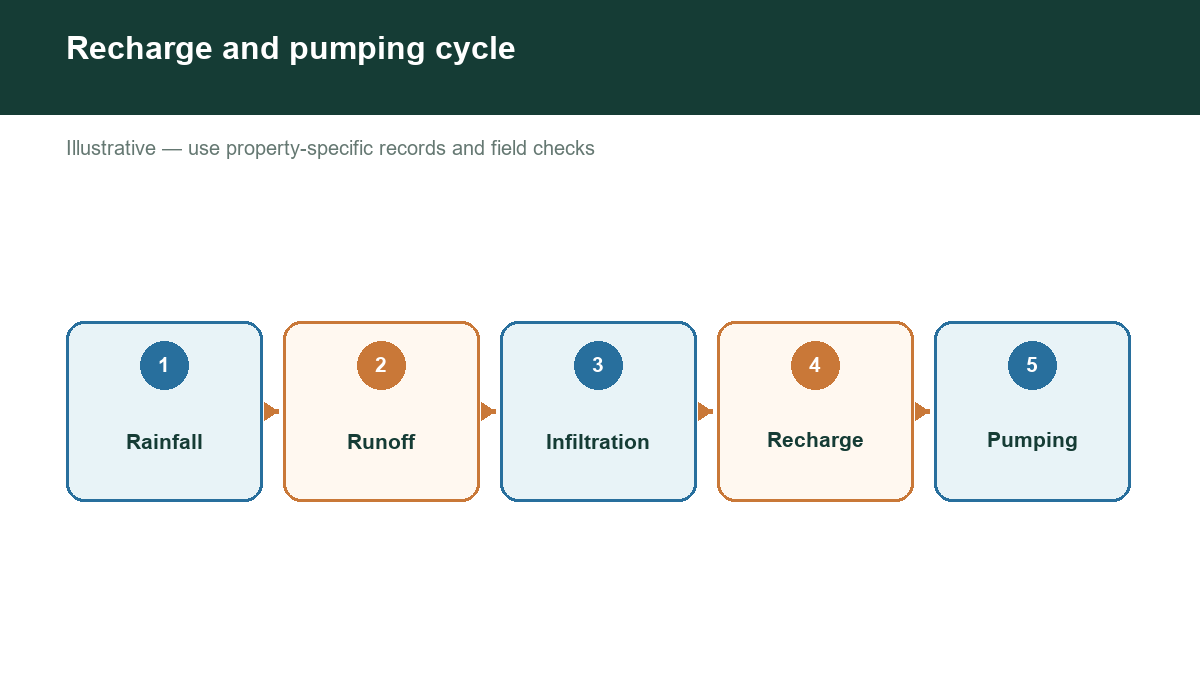
For a well owner, the important question is not simply whether it rained. It is whether water reached the relevant aquifer, how the aquifer responded, and whether pumping continued to remove water faster than conditions improved.
WHAT RECHARGE MEANS
USGS describes groundwater recharge as water entering the saturated subsurface. [1] In a simplified picture, precipitation can infiltrate through the unsaturated zone to the water table, while groundwater then follows flow paths that vary in depth, length, and travel time. [2]
Recharge at one place does not necessarily reach the well nearest to it first. The pathway depends on the geology and groundwater system. A home's source formation may receive recharge outside the property boundary or respond on a different timescale from surface drainage.
WHY A HEAVY STORM DOES NOT GUARANTEE RECOVERY
Rainfall intensity, soil conditions, vegetation, runoff, and aquifer pathways affect how water moves. A flood in a creek is not a direct measurement of recharge to your well's source interval.
The response also differs among Texas aquifers. TWDB notes that the Edwards (Balcones Fault Zone) Aquifer can respond quickly to rainfall, drought, and pumping because of its permeability and karst features. [3] That behavior should not be applied to every deeper or less-connected groundwater system in Texas.
One wet week may produce a short-term rise without resolving a longer-term shortage. Conversely, a well with no immediate rise after rainfall has not necessarily failed permanently. Interpreting either response requires local evidence.
PUMPING CAN COMPOUND DROUGHT EFFECTS
Drought can reduce replenishment while increasing water demand. Additional use for irrigation or other needs can place more stress on the system.
TWDB's drought-status guidance cautions that many aquifers experience annual water-level decline even without drought, and that drought can accelerate the decline. [4] Therefore, not every falling measurement should be attributed solely to the latest dry season.
For a property's research file, distinguish seasonal changes from a longer-term pattern. Ask what the evidence shows before assuming that the next rainy period will restore previous conditions.
HOW TO REVIEW A HYDROGRAPH
A hydrograph plots water levels through time. When reviewing one, first identify the well, aquifer, units, measurement dates, and whether the values represent depth or elevation.
Look for recurring seasonal patterns, unusually sharp changes, missing data, and the broader direction. Compare the period with known pumping changes and local weather information, but do not treat visual correlation as proof of cause.
TWDB's Groundwater and Drought page links to observation-well information and historical well records that can support this research. [5] A monitoring well is background evidence, not a substitute for a measurement at your own well.
WATCH THE DIFFERENCE BETWEEN A MODEL AND A MEASUREMENT
TWDB groundwater availability models combine information about recharge, geology, aquifer properties, water levels, pumping, and other components. [6] They help evaluate regional scenarios and planning questions.
A model result for an area should not be presented as an exact forecast of water depth at a particular house. Check the model's scale, assumptions, and intended use before carrying its conclusions into a property decision.
WHAT WELL OWNERS CAN DO
Record changes in pressure, pumping behavior, water use, and professional water-level measurements. Fix leaks, understand large demand sources, and ask a licensed well professional about protecting equipment under low-water conditions.
Check current guidance from the groundwater authority for the property. Restrictions and application procedures can vary, and a city water announcement may not describe the rule that applies to a private well.
Before buying land, ask for recent performance information and a history that includes dry periods. A test from a favorable season is useful but incomplete evidence of year-round reliability.
BUILD A LOCATION-SPECIFIC PICTURE
Visit https://www.groundwaterassessment.com/ to begin researching Texas groundwater evidence near your property. Use the background to identify trends and questions, then confirm important water-supply assumptions through current field evaluation.