Short answer
A good water well yield is one that can meet the property's planned demand under realistic operating conditions. There is no single gallons-per-minute number that makes every Texas well adequate.
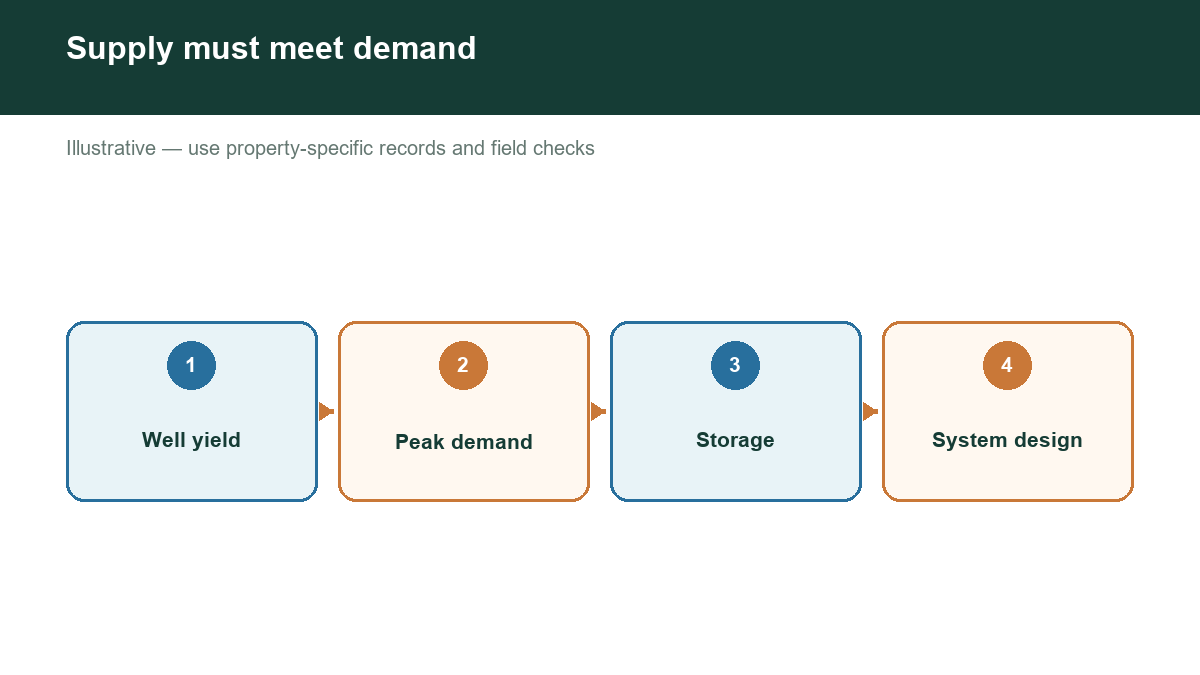
A household using water intermittently has different needs from a ranch watering livestock or a farm running irrigation. The same well can be useful for one purpose and inadequate for another. Start with demand, then evaluate the well's measured response.
WHAT GALLONS PER MINUTE TELLS YOU
Gallons per minute, commonly shortened to GPM, is a flow rate. A well test reporting 6 GPM describes production under the recorded test conditions. It does not automatically establish what the well can produce continuously through a dry summer.
The TDLR well-report form includes a test method, yield, drawdown, and duration. That is a reminder to ask for the whole test, not just its most attractive number. [1]
Also separate well yield from pump capacity. A pump rated to deliver a certain flow is equipment, not proof that the formation can supply that flow at your operating depth. A licensed installer should evaluate the pump's actual operating point and the well's limitations.
DAILY VOLUME AND PEAK FLOW ARE DIFFERENT
Daily volume is how much water you use over a day. Peak flow is how quickly you need it when activities overlap.
For illustration only, a hypothetical property using 360 gallons daily would need 180 minutes of production from a well delivering a steady 2 GPM. That arithmetic does not prove that a 2 GPM well is suitable. Recovery, seasonal changes, usable storage, pump controls, and the actual demand schedule still matter.
Now consider a hypothetical irrigation zone delivering 12 GPM for 45 minutes. It consumes 540 gallons in that one cycle. Adding outdoor use can change a household's water budget substantially, even when indoor use remains unchanged.
These examples are planning calculations, not Texas design standards. Use measured consumption and professional sizing for your property.
STORAGE CAN HELP, BUT DOES NOT CREATE WATER
A properly designed storage system can accumulate water between periods of high demand and supply a short peak through a separate delivery pump. It may be useful when a well's dependable production is below the property's short-term demand.
Storage cannot make up for a persistent shortage in daily supply. It also introduces responsibilities for sanitary protection, controls, maintenance, and water quality. A pressure tank's usable drawdown is not the same as its nominal tank volume, and neither should be confused with a dedicated storage cistern.
Ask an installer to distinguish the well-production system from the household-pressure system and explain how each will be protected during low-water conditions.
REQUEST A MEANINGFUL PERFORMANCE TEST
For a purchase or major expansion, ask a qualified well professional what testing is appropriate. Useful documentation includes the starting water level, pumping rate, duration, change in water level, recovery, and the conditions under which the test was conducted.
USGS guidance explains that apparent and actual declines in yield can arise from different causes, including overly optimistic original estimates, changes in static water level, and changes in specific capacity. [2] A short test should therefore not be presented as a lifetime guarantee.
CHECK THE PROPERTY'S FULL USE PLAN
List the uses the well must support: residents, guests, livestock, gardens, irrigation, workshops, or future buildings. Ask whether treatment equipment will add water demand or limit delivery flow.
Review current requirements with the applicable groundwater district before changing use or production. In parts of the Hill Country, districts publish specific permitting and drilling procedures; do not assume that a neighboring property follows the same rules. [3]
Finally, evaluate quality separately from quantity. TCEQ recommends accredited laboratory testing for private-well drinking water. Plenty of water is not proof of safe drinking water. [4]
RESEARCH THE SUPPLY BEFORE EXPANDING DEMAND
Begin your property research at https://www.groundwaterassessment.com/. Use public well evidence to prepare questions, then obtain current testing and system design before deciding that a well can support a house, ranch, or irrigation project.