Short answer
There is no dependable statewide flat price for drilling a water well in Texas. A realistic budget must account for geology, depth, casing, access, drilling method, pump equipment, electrical work, storage, treatment, testing, permits or district requirements, and the possibility that the first target does not produce the expected water.
Illustrative bid-comparison example
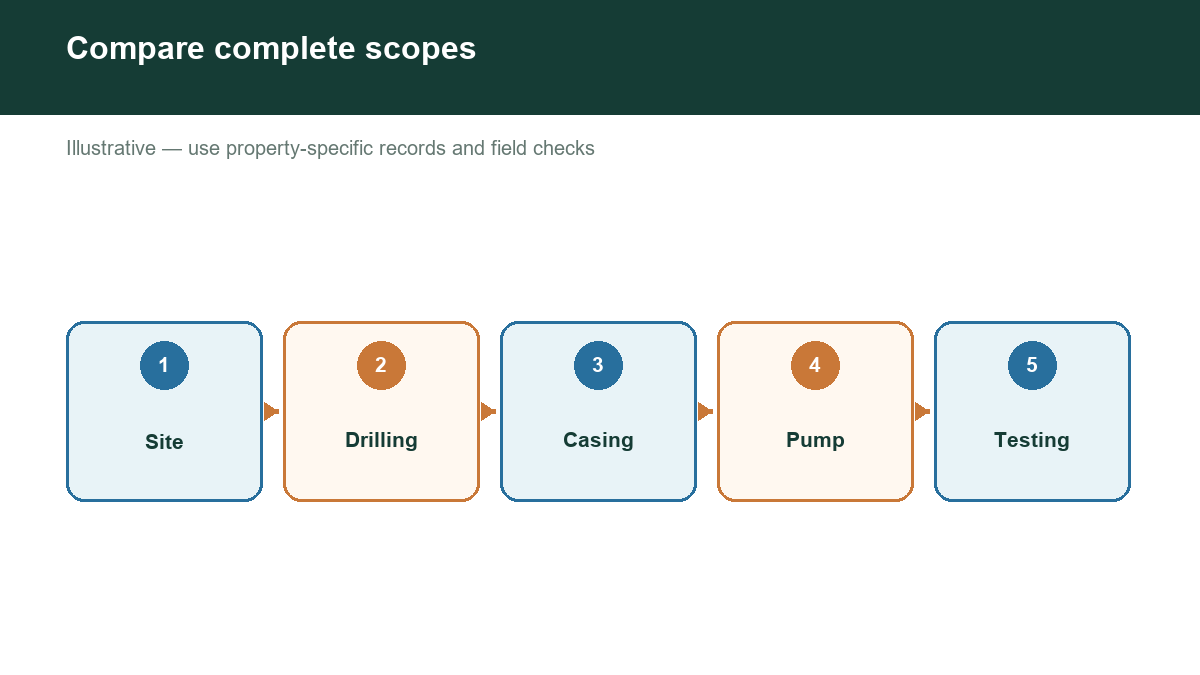
Imagine that one bid includes drilling, casing, sealing, a pump, controls, testing, and completion records, while a lower bid omits the pump and electrical work. The totals are not comparable until both scopes are itemized. This example intentionally uses no dollar figures because local geology, access, depth, equipment, and contractor scope control the actual price.
The main cost drivers
Depth is one of the clearest drivers, but it is not the only one. Hard rock, unstable formations, lost circulation, difficult access, and larger casing can increase drilling time and materials. A deeper well may also require a larger pump, heavier wiring, additional pressure equipment, and more maintenance expense.
The intended use matters. A household well, livestock well, irrigation well, and public-supply well can have very different design and testing requirements. Desired flow rate and storage capacity affect pump sizing. Water quality problems may require filtration, softening, disinfection, or other treatment.
Location matters too. A remote parcel may require longer mobilization and access work. A groundwater conservation district may have local rules affecting well construction, spacing, registration, permits, or production. A property in a sensitive or regulated area may require additional review.
What a quote should include
Ask each driller for a written scope. It should identify whether the price includes mobilization, drilling by the foot or by a fixed bid, casing, screen, grout, well development, yield testing, pump installation, pressure tank, electrical connection, water sampling, permits, and final reporting.
Ask how changes will be handled if the formation differs from expectations. Clarify the cost of additional depth, larger casing, difficult drilling, abandoned holes, and equipment changes. Confirm whether taxes, travel, restoration, and site cleanup are included.
Do not budget only for the hole
The completed water system may include a pump, drop pipe, pitless adapter, pressure tank, controls, wiring, storage tank, treatment equipment, trenching, and connections to the home. A low drilling quote can become a high project cost if these components are excluded.
Before accepting a quote, research nearby wells and the likely aquifer. Nearby records can provide context for expected depth, construction, and reported yield, but they cannot guarantee the result on your parcel. Ask the driller how local records affect the proposed design.
How to compare bids
Compare scopes, not just totals. Check whether the bidders are pricing the same depth, casing, test, and equipment. Verify licensing and ask for references for similar geology and well use. A professional who explains uncertainty clearly is often more useful than a quote that gives a precise number without assumptions.
Because costs change with local market conditions and site-specific conditions, obtain current written bids before relying on any online estimate.
Check groundwater evidence near your Texas property
Our assessment tool can help you organize nearby well evidence before you request bids. That information will not replace a driller’s estimate, but it can help you ask more informed questions about depth, aquifer, yield, and risk.