Short answer
A private well can be one of the most important systems on rural Texas property. Before buying land, research the well’s location, construction, depth, water level, production, water quality, maintenance history, and legal or district requirements.
Illustrative property-research example
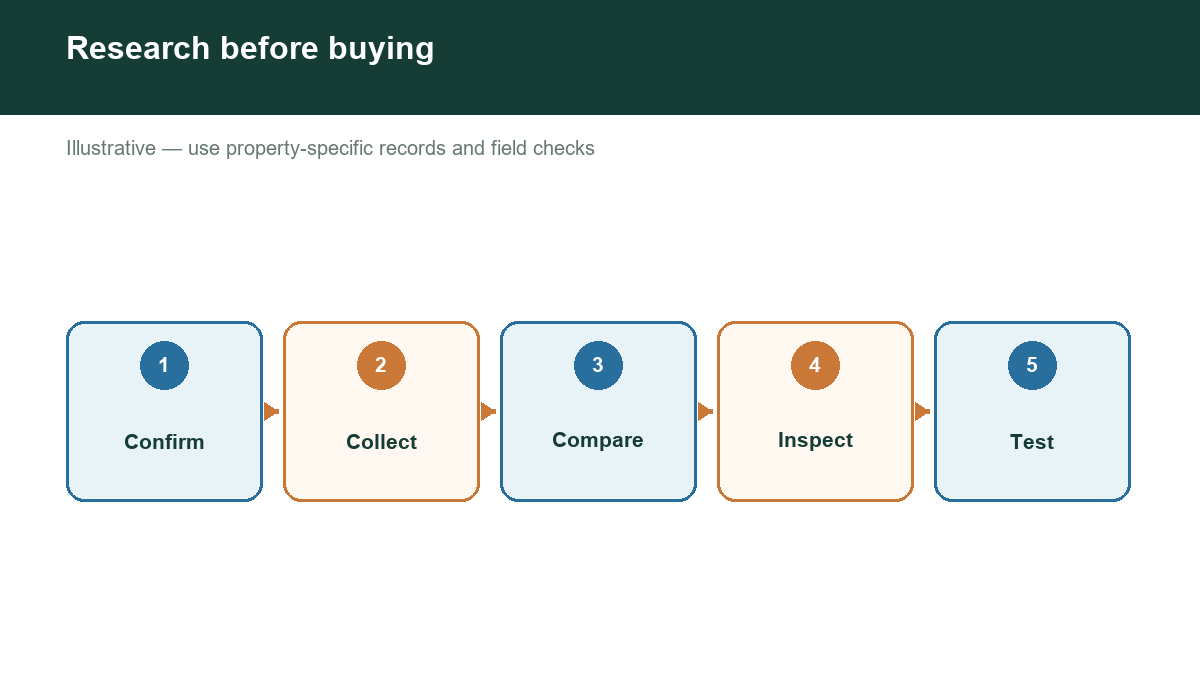
Suppose a mapped well record falls near a parcel but the street description does not match the visible wellhead. Treat that as an unresolved identity question, not proof that the record belongs to the property. Confirm the parcel and well first, compare public records second, and reserve current condition, yield, and water quality for inspection and testing.
Start with the records
Ask the seller for the well report, invoices, water-quality tests, pump information, repair records, and any groundwater district documentation. Then search the public databases. TWDB provides a Groundwater Data Viewer and Submitted Drillers Reports. TCEQ also provides a Water Well Report Viewer with historical reports.
Do not assume that a missing record means there is no well. Older reports may be in a different system, the location may be entered differently, or the well may not have been reported in the searchable database. Search by map, owner, county, street, driller, and approximate date when available.
What to verify
Confirm that the report matches the property. Compare coordinates, owner name, street address, well number, drilling date, and visible well location. Walk the property and locate the casing, cap, electrical equipment, pressure tank, storage tanks, treatment systems, and distribution lines.
Review total depth, casing diameter, screened or open-hole interval, reported water level, pump setting, and reported yield. A high test yield does not necessarily equal the sustainable supply available to a household during drought. Ask how the test was performed and when it occurred.
Test the water
A clear sample is not proof that water is safe. TCEQ recommends that private well owners use an accredited drinking-water laboratory. Testing should be selected for the property’s location and risks; common baseline tests may include bacteria, nitrate, and other constituents recommended by local public-health or water-quality professionals.
Test before closing when possible, and use proper sampling procedures. If the property has agricultural activity, septic systems, oil and gas activity, flooding, or known contamination concerns, ask a qualified professional whether additional analysis is appropriate.
Check the system, not only the water
Have a qualified well and pump professional inspect the well and equipment. Important issues include a damaged or unsecured cap, poor drainage around the casing, exposed wiring, inadequate pressure, corrosion, failing treatment equipment, and a pump that is too deep or too small for the system.
If the well is not being used, ask whether it is properly capped or plugged. Abandoned wells can create safety and contamination risks, and Texas landowners have responsibilities for abandoned wells.
Understand uncertainty
A well report is a historical record, not a current performance guarantee. Water levels change. Pumps wear out. Nearby irrigation can affect pressure and drawdown. A well that supplied one household may not support livestock, landscaping, or a second residence without additional evaluation.
Make the purchase decision evidence-based. Separate what is documented, what is inferred from nearby wells, and what still requires an onsite inspection or test.
Check groundwater evidence near your Texas property
Our assessment tool helps you review public well evidence near a Texas property before you commit to a purchase. Use it as a due-diligence aid alongside a title review, professional inspection, laboratory testing, and local district guidance.