Short answer
Private well owners in Texas are responsible for checking and maintaining the quality of their water. Water can look, smell, and taste normal while containing bacteria, nitrate, metals, salts, or other contaminants. Testing is the only reliable way to understand what is in a sample.
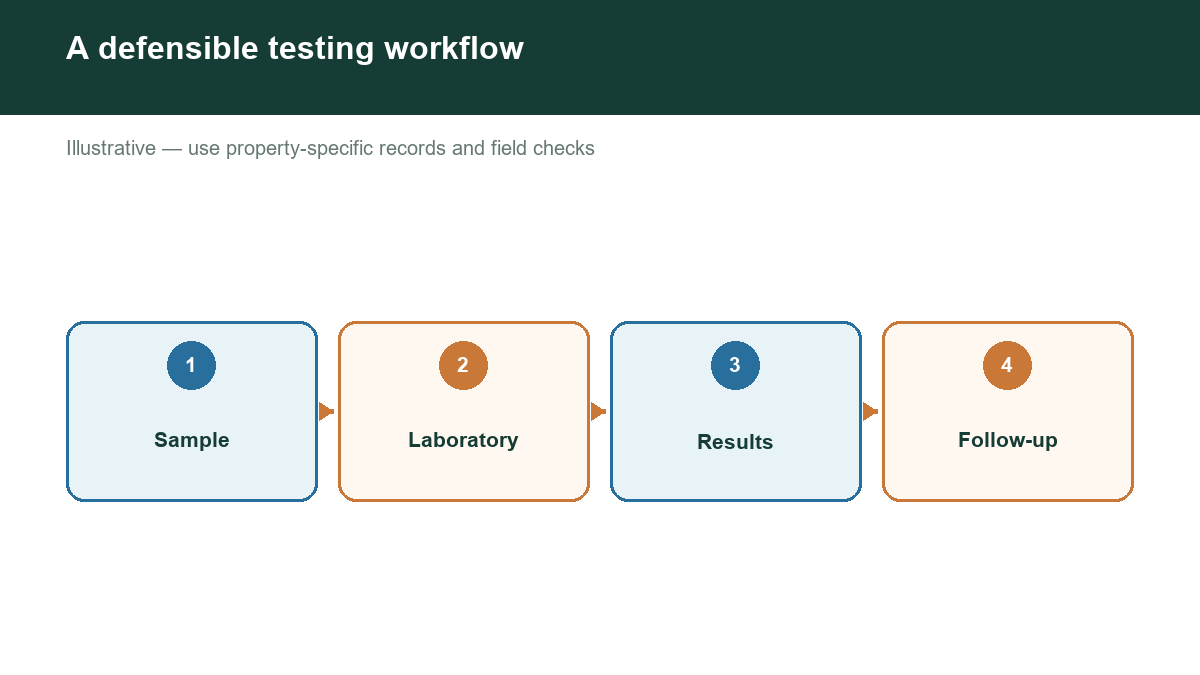
When to test
Test when buying a property, after a new well is drilled, after flooding, after repairs, when taste or odor changes, and when nearby land use or contamination conditions change. A baseline test followed by periodic testing can help identify changes. TCEQ and Texas A&M AgriLife resources can help owners select appropriate tests and sampling procedures.
What to test for
Many households begin with bacteria and nitrate. The right panel depends on location and risk. Consider local geology, agricultural activity, septic systems, oil and gas operations, industrial sites, flooding, corrosion, and known contamination notices. A qualified water professional or public-health authority can help determine whether additional constituents should be included.
Use an accredited laboratory
TCEQ recommends using an accredited drinking-water laboratory for private well testing. Follow the laboratory’s bottle, preservation, timing, and shipping instructions. Improper collection can contaminate a sample or cause a result to be rejected.
TCEQ’s guidance for bacteriological sampling explains how to collect a sample from a private well, send it to an approved laboratory, and review the result. Do not use an informal home test as a substitute for laboratory analysis when making a health or real-estate decision.
How to interpret results
A laboratory result should be interpreted against the applicable drinking-water standard or health guidance, not simply compared with another property’s result. A result can also reflect sampling conditions. If bacteria are detected, avoid assuming that treatment alone solves the problem; inspect the wellhead, cap, plumbing, and nearby sources of contamination.
If a result is concerning, contact the laboratory, local health authority, water professional, or appropriate state agency for next steps. Do not make treatment decisions based only on a generic internet recommendation. Treatment should match the contaminant and be maintained correctly.
Water quality and water quantity are different questions
A well can produce plenty of water that is unsafe to drink, or safe water at a flow rate that does not meet the property’s needs. Evaluate quality, quantity, construction, equipment, and reliability separately.
Check groundwater evidence near your Texas property
Our assessment tool can help you understand the regional and nearby-well context before testing. Public data may identify potential concerns, but it cannot replace a current laboratory result from your property’s own water system.