Short answer
Private-well maintenance is easier when you know what the system looked like and how it performed before a problem developed. A clear record of testing, repairs, pressure changes, and water-use patterns can turn "something seems wrong" into useful information for a service professional.
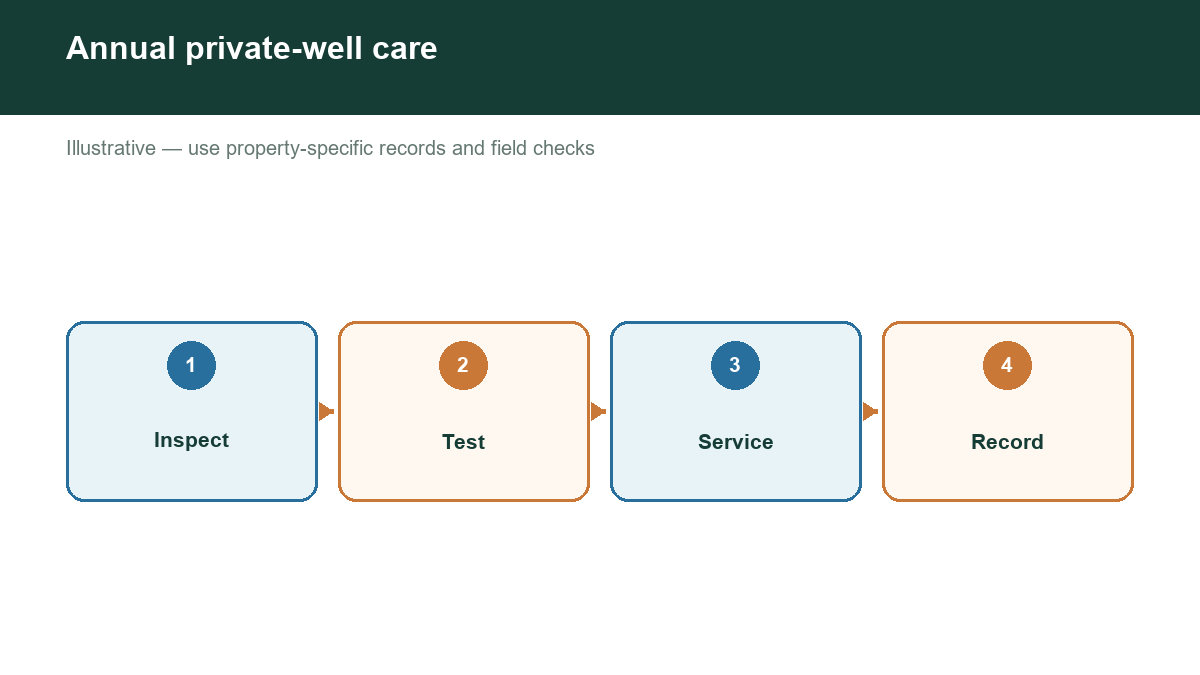
This checklist is a planning aid for Texas well owners, not instructions to open a well, handle electrical equipment, or perform technical repairs.
1. KEEP A COMPLETE WELL FILE
Collect the drilling report, location, total depth, construction details, pump information, installation invoices, treatment manuals, laboratory reports, and district paperwork. Save service-provider contact information where it is easy to find during an outage.
Texas A&M AgriLife's Water Well Basics publication emphasizes records, management of contamination sources, and water testing at least annually. [1] Keeping dated information helps you notice change rather than treating every new result as an isolated event.
If records are missing, request them from the seller, previous service company, driller, or appropriate public-record system. Label unknown details as unknown.
2. CHECK THE WELLHEAD FROM OUTSIDE
During routine property checks, look for visible damage, a loose or missing cap, disturbed soil, standing water, or changes in drainage. Keep the area accessible for inspection and service.
Do not remove the cap or probe the well. Photograph visible concerns and ask a licensed professional whether repairs are needed. Avoid allowing landscaping or storage to hide the wellhead or direct runoff toward it.
Think about nearby contamination sources, including chemicals, fuel, animal areas, and septic problems. AgriLife's septic-system guidance explains the importance of maintaining the system to help protect well water. [2]
3. PLAN WATER TESTING
Use a laboratory and sample panel appropriate to the property. TCEQ recommends accredited drinking-water laboratories for private wells. Follow the laboratory's collection instructions and confirm which samples should be collected before or after treatment. [3]
Annual testing provides a recurring checkpoint, but an annual calendar should not delay testing after flooding, repairs, a loss of pressure, or a suspected contamination event. Ask the laboratory or local health authority what follow-up is appropriate to the incident.
Do not interpret taste, smell, or clarity as proof that water is safe. Keep results for both source water and treated water when they are collected for different purposes.
4. NOTICE CHANGES IN PERFORMANCE
Record unusual pressure fluctuations, frequent pump cycling, sediment, air at fixtures, or longer-than-usual recovery after heavy use. Note when the symptoms happen and what else was running.
These observations are not a diagnosis. They help a service professional distinguish possible plumbing, equipment, treatment, and water-supply problems. Do not repeatedly run an underperforming system to see whether it will "fix itself."
For technical checks, use a qualified professional. TDLR provides the official Texas program for water-well drillers and pump installers, including licensing information. [4]
5. SERVICE TREATMENT EQUIPMENT
Follow manufacturer and installer schedules for filters, disinfection systems, softeners, and other equipment. Record cartridge changes, service dates, alarms, and settings changed by a professional.
Treatment should be selected for the contaminant and use. A maintenance checklist should include verification that treatment is working, not simply evidence that a device has power or that a filter was replaced.
6. PREPARE FOR DROUGHT AND HEAVY DEMAND
Repair leaks and understand which activities place the largest demand on the system. Before adding irrigation or livestock, evaluate the current well rather than relying only on its original reported yield.
AgriLife provides drought guidance for protecting well equipment and supply when groundwater levels are low. [5] Ask a professional whether low-water protection or other system changes are appropriate for your equipment.
7. DON'T IGNORE AN UNUSED WELL
Keep track of every well on the property, including those not supplying the home. An unused well's condition and legal status need evaluation. AgriLife's abandoned-well guidance recommends contacting the local district, a licensed professional, or TDLR when status is uncertain. [6]
BUILD A BASELINE FOR YOUR PROPERTY
Visit https://www.groundwaterassessment.com/ to begin reviewing the groundwater context near your Texas property. Combine that background with your own testing and service history; public data cannot certify that your well is maintained or your water is safe.
Sources
- [1] Texas A&M AgriLife Extension: TWON Water Well Basics.
- [2] Texas A&M AgriLife Extension: Maintain Your Septic System to Protect Well Water.
- [3] TCEQ: How Is My Drinking Water Quality?
- [4] TDLR: Water Well Drillers and Pump Installers.
- [5] Texas A&M AgriLife Extension: Protect Your Water Well During Drought.
- [6] Texas A&M AgriLife Extension: Abandoned Water Wells.