Short answer
Researching a Hill Country well starts with a question more useful than "How deep is the Trinity Aquifer?": Which water-bearing unit serves this location, and what does local evidence show about its performance?
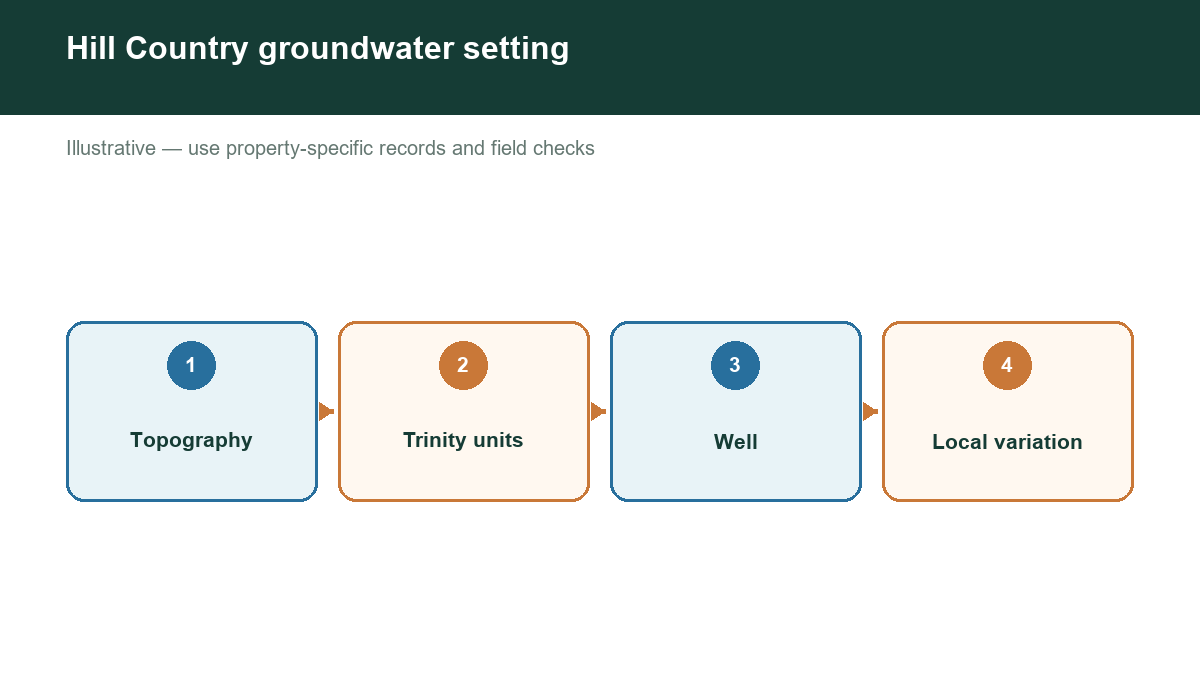
The Trinity Aquifer extends across much of Central and northeastern Texas. TWDB describes a system containing several water-bearing formations, including limestone, sand, clay, gravel, and conglomerate. It includes both confined and unconfined conditions. [1]
That diversity is why one depth or yield cannot describe every Trinity well near Dripping Springs, Wimberley, or elsewhere in the Hill Country.
THE AQUIFER NAME IS NOT A WELL DESIGN
In Hill Country discussions, you may encounter upper, middle, and lower Trinity terminology. TWDB's Hill Country groundwater-model resources provide regional context for the system. [2] Local records and a qualified professional are still needed to connect that context to a parcel.
Ask which unit a proposed well would target and why. A report that only says "Trinity" may leave important completion details unresolved. Nearby wells can be useful comparisons when they access the same interval and occupy a similar geologic setting.
Do not infer a drilling target from map color alone. Outcrop boundaries, subsurface formations, and completion depths describe related but different information.
COMPARE NEARBY WELLS SELECTIVELY
Begin with a modest search area around the parcel, then expand if records are sparse. Organize findings by location, drilling date, use, total depth, reported water level, and completion interval.
Give priority to wells that are relevant to the intended use. A commercial or municipal well may reflect a different construction strategy from a domestic well. A nearby well with uncertain location or missing completion information belongs in a separate, lower-confidence group.
Watch for mixed results. If comparable records span a wide range, report that variability instead of forcing an attractive average. The inconsistency may be the most useful finding for budgeting and due diligence.
ASK ABOUT WATER QUALITY BEFORE COMMITTING
TWDB notes that Trinity groundwater chemistry varies across the system and that dissolved constituents can increase as the aquifer becomes deeper in some areas. [1] This regional observation does not diagnose the water at a particular homesite.
Obtain laboratory results from the actual well when evaluating an existing property. When planning a new well, discuss local water-quality history and the possibility of treatment with the driller. Include treatment, maintenance, and testing in the full water-system budget.
A seller's statement that water is "hard" is not a substitute for a test panel appropriate to the site.
LOCAL RULES CAN CHANGE THE PROJECT
The Hill Country contains multiple groundwater jurisdictions. For example, Hays Trinity GCD publishes construction-notification procedures and drought-related limitations on certain applications. [3] Comal Trinity GCD publishes rules addressing registration, drilling authorization, well construction, and spacing. [4]
These examples show why local verification matters; they are not statewide requirements or evidence that either district governs every Hill Country parcel. Confirm the boundary, aquifer, proposed use, and current rules directly with the responsible authority.
Before a land purchase, ask whether existing records match the current owner and actual use. Before drilling, ask what must be completed before work begins and whether drought provisions affect the project schedule.
BUILD A PROPERTY-SPECIFIC DECISION FILE
Keep the survey, mapped well evidence, construction records, laboratory reports, district correspondence, and written drilling assumptions together. Identify which facts are documented and which remain estimates.
For a high-cost project or inconsistent local evidence, consider a hydrogeologist's evaluation. The goal is not to eliminate every uncertainty; it is to understand which uncertainties matter enough to change your purchase, budget, or water-use plan.
START YOUR HILL COUNTRY GROUNDWATER RESEARCH
Visit https://www.groundwaterassessment.com/ to begin researching groundwater evidence near your Texas property. Follow the regional context with local records, current testing, and district guidance before relying on a Trinity well for your intended use.
Sources
- [1] TWDB: Trinity Aquifer. Regional geology and water-quality overview.
- [2] TWDB: Hill Country Portion of the Trinity Aquifer Groundwater Availability Model.
- [3] Hays Trinity Groundwater Conservation District: Forms. Check current application and drought provisions.
- [4] Comal Trinity Groundwater Conservation District: Rules.